


Cooler Nights, More Company
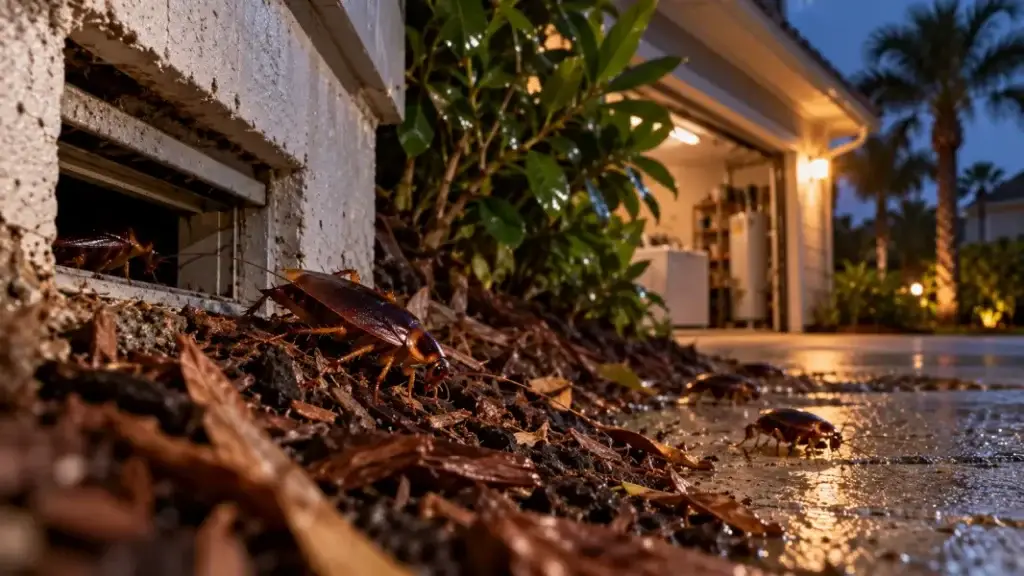
Atlantic Beach homeowners know the palmetto bug — Northeast Florida’s name for the large, dark smokybrown cockroach that thrives in humid, coastal conditions. Most of the year, they stay outdoors in mulch beds, leaf litter, and under debris. But as September nights start dropping into the 60s, outdoor conditions cool faster than the inside of a home, and palmetto bugs go looking for somewhere warmer and more humid to ride it out.
That “somewhere” is usually a garage, laundry room, or crawlspace — anywhere with steady warmth and moisture close to an exterior wall.
Why Atlantic Beach Sees More Activity Than Inland Neighborhoods
Coastal proximity changes the equation in a few specific ways:
- Higher ambient humidity. Being blocks from the ocean keeps air moisture elevated even as temperatures drop, which is exactly what smokybrown cockroaches prefer.
- Dense landscaping near foundations. Mulch beds, dense shrubbery, and irrigation common in Atlantic Beach yards give palmetto bugs cover right up to the exterior wall line.
- Older beach-community construction. Homes with crawlspaces, vented foundations, or less-sealed utility penetrations offer more entry points than newer slab construction inland.
The result is that Atlantic Beach properties tend to see palmetto bug pressure earlier in the fall transition than homes further from the coast.
What to Look For
Palmetto bugs are mostly active at night, so signs are often more noticeable than the bugs themselves:
- Egg capsules (oothecae) — dark, oblong capsules tucked into cracks, behind appliances, or in garage corners
- A musty odor in enclosed spaces like garages or under-sink cabinets where activity has built up
- Sightings near drains, water heaters, or laundry areas — anywhere with consistent moisture
- Bugs appearing after dark when lights are turned on in a garage or utility room
Unlike German cockroaches, palmetto bugs generally don’t establish large indoor colonies — but a steady trickle indoors usually means an active outdoor population close to the house.
Why Perimeter Treatment Matters More Than Indoor Spraying
Because palmetto bugs are primarily an outdoor pest looking for temporary shelter, indoor treatment alone tends to miss the source. Effective control focuses on the perimeter:
- Exterior barrier treatment around the foundation, entry points, and landscaping beds where palmetto bugs stage before coming indoors
- Reducing harborage — trimming vegetation back from the foundation and addressing mulch depth against exterior walls
- Sealing entry points at utility penetrations, weep holes, and garage door gaps
- Targeted indoor treatment only where activity has already moved inside
This layered approach is the basis of Crown Pest Control’s residential pest control service — treating the yard and entry points, not just the rooms where bugs happen to be seen.
Getting Ahead of the Fall Transition in Atlantic Beach
Because coastal humidity keeps palmetto bug pressure high later into the year than inland Jacksonville, a perimeter treatment now — before nights get consistently cool — heads off the indoor sightings that tend to follow.
Crown Pest Control has served Atlantic Beach and the surrounding coastal communities since 1979, with no-upsell perimeter treatments built for the humidity and landscaping conditions specific to beach-area homes.
Seeing palmetto bugs in the garage or laundry room? Contact Crown Pest Control to schedule a perimeter treatment.


