


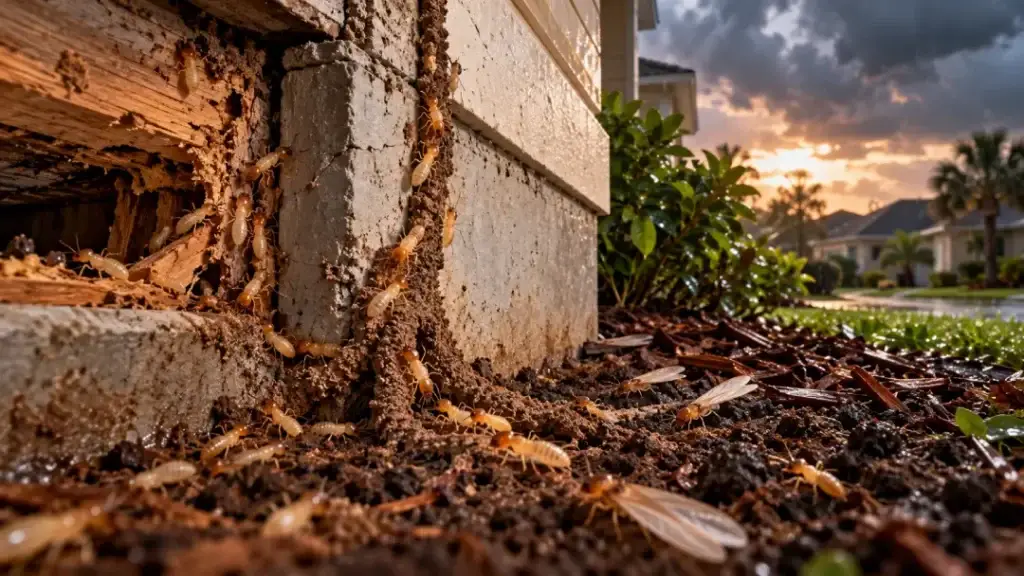
Why This Time of Year Matters for Termites
Northeast Florida’s late-summer storm pattern leaves soil saturated for days at a stretch, and Nocatee’s newer developments — many built on reclaimed wetland and low-lying coastal plain — hold that moisture longer than higher, older parts of Jacksonville. For subterranean termites, damp soil next to a foundation isn’t just tolerable, it’s the exact condition their colonies need to travel, feed, and expand undetected.
By the time rain lets up in fall, colonies that found a way in during the wet months have often already been established for weeks. That makes late summer the point where a moisture problem quietly becomes a termite problem.
Why Nocatee Foundations Are Worth a Closer Look
A few things about the area raise the stakes:
- Slab-on-grade construction. Most Nocatee homes sit on concrete slabs, and subterranean termites travel through soil directly beneath and around that slab — out of sight until damage or swarming shows up inside.
- Sandy, high-water-table soil. Coastal soil composition drains unevenly and holds moisture near foundations longer after heavy rain than inland clay-based soils do.
- New landscaping and irrigation. Sprinkler systems and fresh mulch beds, common in newer Nocatee neighborhoods, can keep soil against the foundation damp even between rain events.
None of this guarantees termite activity — it means the conditions that support it are more persistent here than in drier parts of Jacksonville.
Signs Worth Checking For
Subterranean termites are built to stay hidden, so most of the visible signs show up after activity has been underway for a while:
- Mud tubes — pencil-width tunnels running up foundation walls, piers, or slab edges, used to travel between soil and wood while staying protected from open air
- Swarmers — winged termites (or their discarded wings) near windows, doors, or light fixtures, typically appearing after a rain event
- Wood that sounds hollow when tapped, or paint that looks bubbled or cracked along baseboards and door frames
- Foundation cracks or gaps where the concrete meets soil, especially near irrigation lines or dense mulch beds
A visible sign at this stage usually means the colony has been active for some time already.
What a Proper Moisture and Termite Check Covers
An effective inspection doesn’t stop at looking for termites themselves — it looks at the conditions letting them in:
- Foundation perimeter walk-through, checking for mud tubes, cracks, and soil contact points
- Moisture assessment around irrigation lines, downspouts, and low-lying grading that keeps soil wet against the slab
- Interior checks near baseboards, door frames, and plumbing penetrations where termites most often surface indoors
- A non-repellent liquid soil barrier where treatment is warranted, applied to create a protective zone termites can’t detect and avoid
This is the moisture-and-termite check behind Crown Pest Control’s foundation inspections — treating the soil conditions, not just the termites currently visible.
Getting Ahead of It in Nocatee
Because Nocatee soil holds moisture longer after storms than much of Jacksonville, a foundation that looked fine in spring can develop a termite-friendly moisture pocket by early fall without any obvious warning. A proactive check after this season’s rain is far less costly than repairs after termites reach framing or subflooring.
Crown Pest Control has served Nocatee and the surrounding St. Johns corridor since 1979, with straightforward, no-upsell inspections and treatment — including the foundation and moisture checks that matter most after a wet summer.
Want your foundation checked before termite season peaks? Contact Crown Pest Control to schedule an inspection.


