


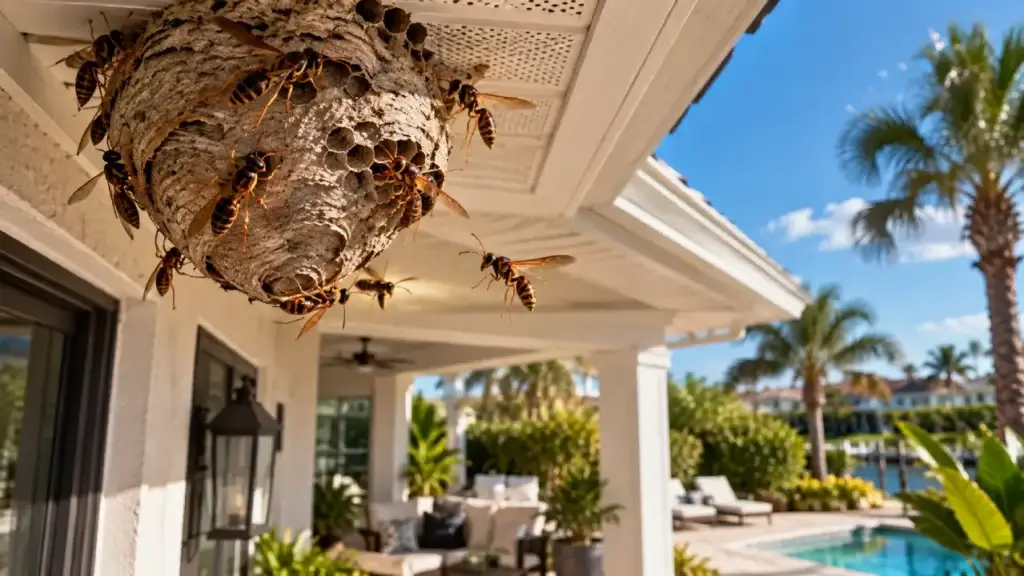
Why Late Summer Is Peak Aggression Season
Paper wasp and hornet colonies build all summer, and by late August into September they’re at their largest — which also makes them their most defensive. A colony that seemed harmless in June, tucked quietly under an eave, can be a genuine hazard by the time it’s had a full season to grow. Established colonies also start producing new queens this time of year, which means more activity around the nest as workers defend it.
For Ponte Vedra Beach homeowners, that timing lines up with peak outdoor season — porches, patios, and pool decks getting the most use right as nests overhead are at their most defensive.
Where Nests Tend to Hide in Ponte Vedra Beach
Coastal architecture and landscaping in the area create a few consistent hot spots:
- Covered porches and lanais — protected overhangs are ideal for paper wasps building open, umbrella-shaped nests
- Eaves and soffit returns — especially on homes with detailed roof trim, which gives wasps and hornets sheltered ledges
- Pool equipment enclosures and outdoor storage — quiet, low-traffic areas that go unchecked for weeks at a time
- Dense coastal landscaping — shrubs and hedges near walkways, where ground-nesting yellow jackets are more likely than the other two
Because so much of Ponte Vedra Beach living happens outdoors, these are also the exact spots people walk past daily without noticing a nest until it’s already established.
Signs a Nest Has Grown Past “Wait and See”
- Visible increase in wasp traffic around a single point on the eave, porch ceiling, or shrub line
- An open, paper-like nest with visible individual cells, typically grayish and umbrella-shaped for paper wasps
- Ground activity — wasps flying in and out of a small hole in the lawn or mulch bed, a sign of yellow jackets rather than paper wasps or hornets
- Increased defensiveness near the nest, such as wasps reacting to movement or vibration from several feet away
By this point in the season, a small nest noticed in June can easily be a large, actively defended colony.
Why DIY Removal Gets Riskier Late in the Season
Late-season colonies are larger, more populous, and more likely to defend aggressively than the same nest would have been earlier in summer — which is exactly when DIY removal attempts go wrong. Proper removal involves:
- Identifying the species — paper wasps, hornets, and yellow jackets require different approaches and carry different risk levels
- Treating the nest directly with equipment that allows safe distance, particularly for high eave or soffit locations
- Removing the nest once activity has stopped, since old nests can attract new colonies to the same spot next season
- Checking nearby structures for secondary nests, since multiple colonies on one property aren’t unusual late in the season
This is the approach behind Crown Pest Control’s stinging insect removal — high-reach knockdown for active nests under eaves and porches, handled without putting homeowners at risk.
Getting Nests Cleared Before Peak Outdoor Season Ends
With porches, pools, and patios still in heavy use, a late-season nest is one of the more immediate pest risks a Ponte Vedra Beach home can have. Waiting it out isn’t a great option — colonies don’t shrink until temperatures drop for good.
Crown Pest Control has served Ponte Vedra Beach and the surrounding coastal area since 1979, with safe, no-upsell removal of wasp, hornet, and yellow jacket nests.
Spotted a nest under an eave or porch ceiling? Contact Crown Pest Control for prompt removal.


